
Step 01
Sample and identify
Samples are cut from the delivered bundles, with the heat number, mill mark, diameter and consignment recorded so results can be traced back to the batch.
Reinforcement is bought by grade and specified by strength, but the grade is a claim until somebody tests the bar. We test what actually arrived on your site.
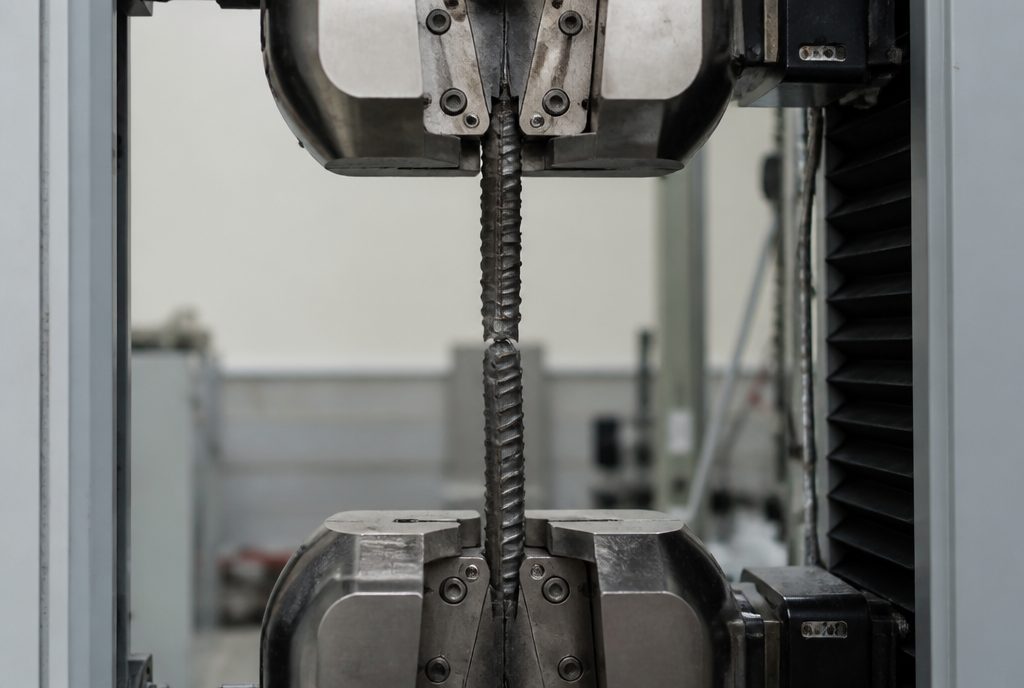
Tensile testing pulls a full section sample to failure and records the load throughout. That gives yield strength at the point the steel stops behaving elastically, ultimate tensile strength at peak load, and elongation measured across a gauge length after the two halves are fitted back together. All three matter: strength alone without ductility gives a structure that fails without warning.
The ratio of ultimate to yield strength is a ductility requirement in seismic design, because a section has to be able to hinge and redistribute load rather than snap. Codes set a minimum ratio for exactly that reason, and a bar can meet its yield requirement while failing the ratio.
Bend and rebend testing checks that the steel tolerates being formed without cracking, which matters for stirrups and every bent bar on site. Unit weight per metre is checked as well, since underweight bar is a common way for the delivered section to fall short of the nominal diameter it was sold as.
The sequence we follow on site and in the laboratory, and the point of each stage.
Samples are cut from the delivered bundles, with the heat number, mill mark, diameter and consignment recorded so results can be traced back to the batch.
A measured length is weighed to determine mass per metre, and the effective diameter is calculated and compared to the nominal size.
The full section specimen is gripped and loaded at the specified rate to failure, recording yield, ultimate load and the load extension behaviour.
The fractured halves are fitted together and the gauge length is re measured to give percentage elongation.
Specimens are bent around a mandrel of the specified diameter, and for rebend are aged and bent back, then examined for cracking on the outer surface.
Every result is reported with its method reference and the calibration status of the instrument used.
What engineers most often ask us about steel testing.
Most investigations combine several of these. We scope them together so you are not paying to mobilise twice.
Concrete is specified by a strength it will not reach for 28 days, on a site where it is placed in minutes.
Read more
Find the steel before you cut, drill or core, and check that the cover protecting it is what the drawing said it would...
Read more
Whether the asphalt that arrived matches the asphalt that was specified, and whether what was laid was compacted...
Read moreSend us the location, the structure and your programme. You get a scoped quotation with the standard, the number of tests and the turnaround written into it.