
Step 01
Define the scan area
The member and grid are agreed and marked, with drawings reviewed beforehand where they exist so that findings can be compared against them.
Find the steel before you cut, drill or core, and check that the cover protecting it is what the drawing said it would be.
An electromagnetic cover meter induces a field in the concrete and detects the disturbance caused by steel. It locates bars, measures the depth of cover over them and, within limits, estimates the diameter. It is quick, cheap and accurate at shallow depths, which covers most cover survey work.
Ground penetrating radar goes further. It sends a short electromagnetic pulse into the concrete and times the reflections, which lets it see deeper, resolve two layers of reinforcement, and find things a cover meter cannot: voids, ducts, conduits and post tensioning tendons. On a congested slab, radar is often the only method that gives a usable picture.
Two jobs dominate the work. The first is safety: knowing exactly where the steel and the tendons are before anyone cores or drills, because cutting a post tensioning tendon is both dangerous and very expensive. The second is durability: cover depth is what protects reinforcement from chloride and carbonation, and in coastal Karachi a shortfall in cover is a direct shortfall in service life.
The sequence we follow on site and in the laboratory, and the point of each stage.
The member and grid are agreed and marked, with drawings reviewed beforehand where they exist so that findings can be compared against them.
The surface is swept in two orthogonal directions to locate every bar, and bar positions are marked on the concrete as they are found.
Cover is measured at each located bar, with the meter set for the estimated diameter, and a statistical spread reported rather than a single figure.
GPR is run where reinforcement is congested, cover is deep, a second layer is expected, or tendons and voids must be identified.
Safe drilling and coring zones are marked directly on the structure, and results are reported against the specified cover and detailing.
Every result is reported with its method reference and the calibration status of the instrument used.
What engineers most often ask us about reinforcement bar scanning.
Most investigations combine several of these. We scope them together so you are not paying to mobilise twice.
Concrete is specified by a strength it will not reach for 28 days, on a site where it is placed in minutes.
Read more
The fastest way to compare concrete across a structure.
Read more
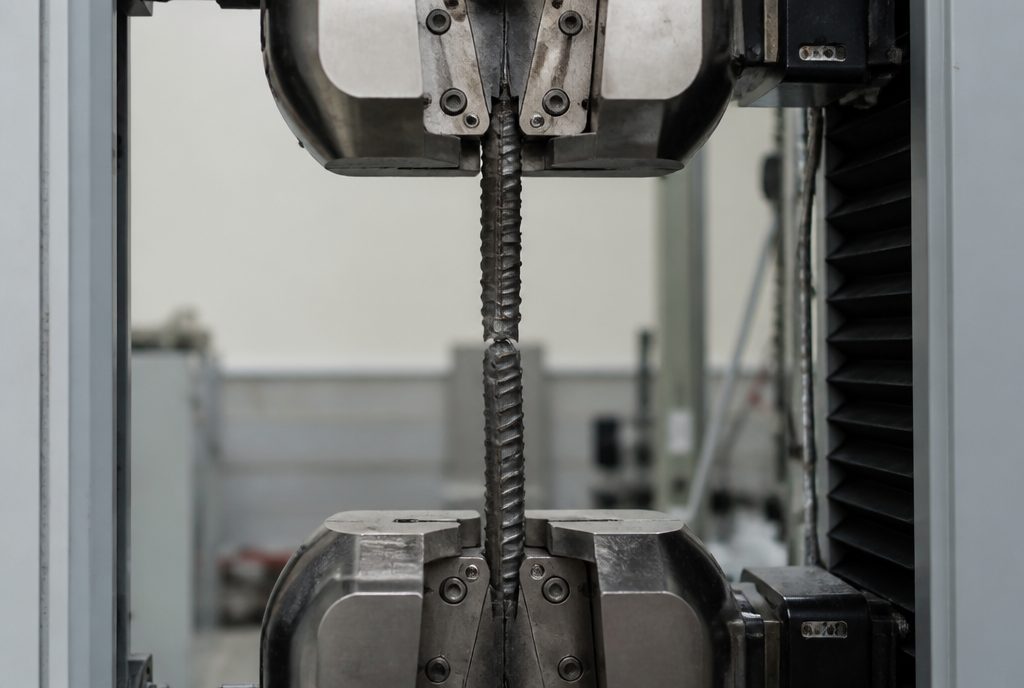
Reinforcement is bought by grade and specified by strength, but the grade is a claim until somebody tests the bar.
Read moreSend us the location, the structure and your programme. You get a scoped quotation with the standard, the number of tests and the turnaround written into it.