
Step 01
Prepare surfaces
Test areas are ground smooth to remove loose material, render and carbonated surface layer, since any of these will distort the rebound.
The fastest way to compare concrete across a structure. It is a surface hardness measurement, not a strength test, and it earns its place when you read it as a map rather than as a number.
A spring loaded mass is released against the concrete surface and the distance it rebounds is recorded. Harder, stiffer surface concrete returns a higher rebound number. Converting that number to a compressive strength relies on a correlation curve, and the generic curve supplied with the instrument can be out by a wide margin on any particular concrete.
Where the method is genuinely strong is comparison. Take readings on a grid across a slab, a set of columns or a whole floor and the variation stands out immediately: the column that was poorly compacted, the bay that was cured badly, the area affected by a cold joint. That map is reliable even when the absolute numbers are not.
To get a defensible strength, the hammer is calibrated against cores taken from the same structure. A handful of cores establishes the site specific correlation, and the hammer then extends that correlation across hundreds of locations at a fraction of the cost. Used that way it is a serious assessment tool; used alone as a strength meter it is not.
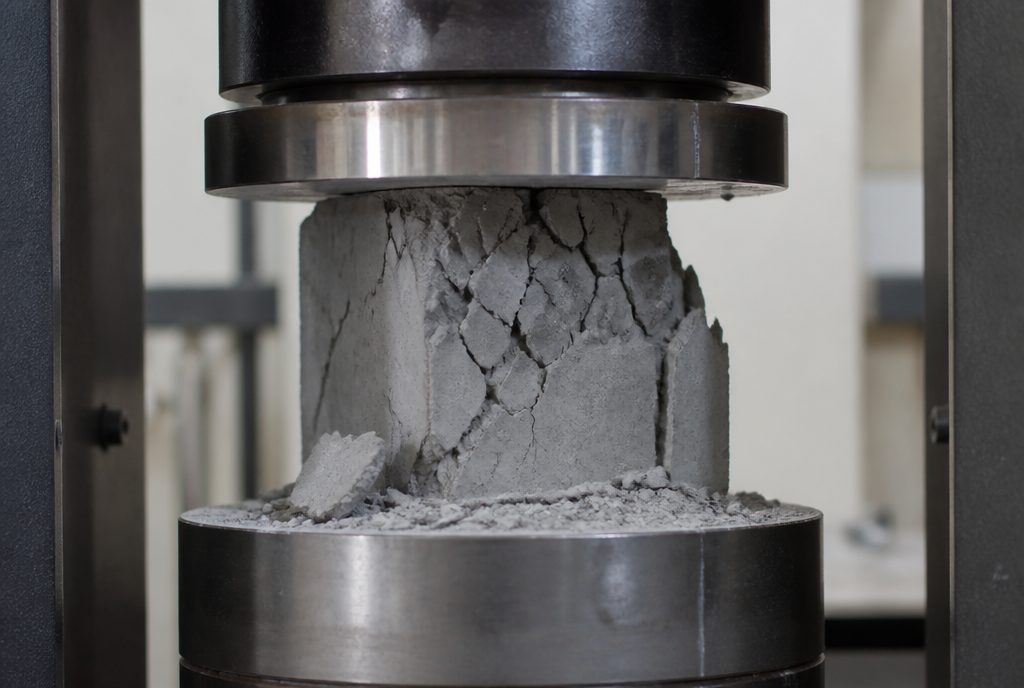
The sequence we follow on site and in the laboratory, and the point of each stage.
Test areas are ground smooth to remove loose material, render and carbonated surface layer, since any of these will distort the rebound.
A grid of test points is set on each member, spaced at least 25 mm apart and clear of reinforcement located by cover meter.
Ten to twelve readings are taken per location, with the hammer held perpendicular to the surface and the impact direction recorded for correction.
Outliers are discarded per the standard and the median rebound number is taken, corrected for the angle of the hammer.
Where a strength value is required, cores are taken at selected points and a site specific correlation is established and applied.
Every result is reported with its method reference and the calibration status of the instrument used.
What engineers most often ask us about Schmidt hammer test.
Most investigations combine several of these. We scope them together so you are not paying to mobilise twice.
Concrete is specified by a strength it will not reach for 28 days, on a site where it is placed in minutes.
Read more
Find the steel before you cut, drill or core, and check that the cover protecting it is what the drawing said it would...
Read more
A cast in place pile is concreted into ground nobody can see, and its defects are invisible the moment it is complete.
Read moreSend us the location, the structure and your programme. You get a scoped quotation with the standard, the number of tests and the turnaround written into it.