
Step 01
Prepare the borehole
A dedicated borehole is cased with PVC and the annulus fully grouted, so the casing is coupled to the ground rather than floating in slurry.
Seismic design needs stiffness at very small strain, which no laboratory sample can give you reliably. We measure wave velocity in the ground itself, down the borehole, layer by layer.
A borehole is cased and grouted, then a triaxial geophone is clamped at successive depths. A shear source at the surface, usually a weighted plank struck from both ends, sends a polarised shear wave down to the receiver, and the travel time to each depth gives the shear wave velocity of each layer.
Shear wave velocity gives you small strain shear modulus directly, which is the stiffness that governs foundation response to vibration and to earthquake shaking. Compression wave velocity, recorded from a vertical strike, gives Poisson ratio when paired with the shear velocity.
The headline number is Vs30, the time averaged shear wave velocity over the top 30 metres. It is what building codes use to place your site in a seismic class, and in Pakistan that classification drives the design response spectrum. Karachi and much of Sindh sit on ground where this classification genuinely changes the design forces.
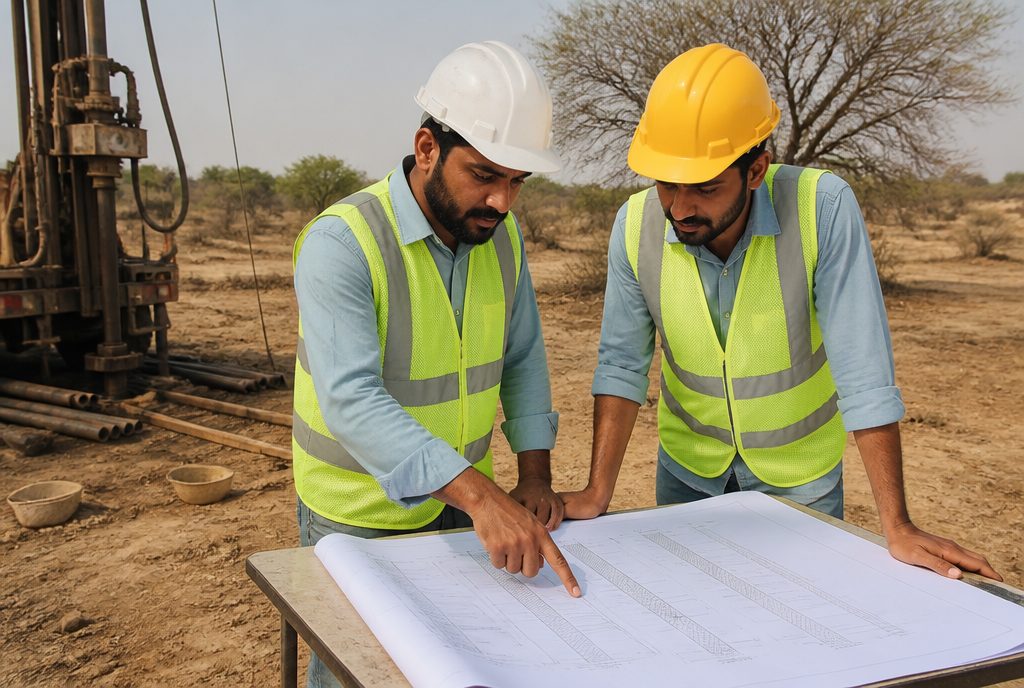
The sequence we follow on site and in the laboratory, and the point of each stage.
A dedicated borehole is cased with PVC and the annulus fully grouted, so the casing is coupled to the ground rather than floating in slurry.
A shear source is set at the surface at a fixed offset, weighted down, and struck from each end so the shear arrival can be identified by polarity reversal.
A triaxial geophone is clamped against the casing wall at one metre intervals, and records are taken at each depth with repeat strikes stacked to improve the signal.
Shear arrivals are picked on the reversed traces where the polarity flips, which is far more reliable than picking a first break by amplitude alone.
Travel times are corrected for the source offset and converted to interval velocities, then to shear modulus, Poisson ratio and the Vs30 average.
Every result is reported with its method reference and the calibration status of the instrument used.
What engineers most often ask us about downhole seismic test.
Most investigations combine several of these. We scope them together so you are not paying to mobilise twice.

The starting point of nearly every investigation.
Read more
A non intrusive way to read the ground between boreholes, and the measurement earthing engineers and pipeline designers...
Read more
The laboratory is where samples become design parameters.
Read moreSend us the location, the structure and your programme. You get a scoped quotation with the standard, the number of tests and the turnaround written into it.